
Ian Guthrie has over 20 years of experience across analytics, pricing, IT, and business strategy. He’s built a diverse career driving data-led transformation and operational success; with a leadership background includeing serving as a pricing leader for three companies and directing analysis and business intelligence initiatives for over a decade. As a Certified Fraud Examiner, he also applied forensic accounting expertise at a Washington, D.C., firm. Since 2013, Ian has advised roughly 20 clients as a management consultant while maintaining a strong technical foundation in IT—having developed around 30 custom business applications and led enterprise-scale implementations for platforms like SAP, Oracle, DB2, and Google BigQuery. He started developing trading systems around 2010 and developed over 100 different trading related algorithms. He started live trading various HFT systems in June 2025.
Ian was formerly very active in the Charlotte Standup comedy scene – but lately not so much. From 2005-2008 he helped start and run a mic off and on at a place called SK Net. This later became Crown Station and moved to NoDa. He still dabbles from time to time. He started working in cartoon animation in 2024, and has been making his own animated cartoons for a couple of years
“Adventures in High Frequency Trading”
Ian and his wife, Ashly, will present an overview of high-frequency trading (HFT), tracing its evolution by comparing past and present markets before diving into the mechanics of “seeking alpha” and avoiding “fool’s gold.” It highlights the technology required to build these systems as well as risk management, common technical bugs, and the psychological demands on traders. Finally, it wraps up by examining the current state of HFT and outlining potential future directions for the industry.

Zoe Van Kirk and Juliet McGee are licensed therapists at Grey Embraced Psychology, a Charlotte practice that believes healing doesn’t have to fit inside a box. Together, they specialize in trauma, anxiety, depression and personality disorders using evidence-based approaches that are anything but cookie-cutter.
Zoe is a Certified Therapeutic Game Master and Dungeon Master who loves making neuroscience tangible through tabletop role-playing games and other creative interventions. They have a special passion for supporting people in high-demand professions, including healthcare workers and first responders, and for making therapy more engaging and accessible to neurodivergent communities.
Juliet is the founder of Grey Embraced Psychology, a practice built on the idea that life rarely exists in black and white. She believes exceptional therapy can be both scientifically grounded and down-to-earth, creative and unconventional. Juliet works with couples and individuals, with a focus on supporting couples navigating fertility and individuals working through trauma, utilizing a diverse toolkit of evidence-based therapies, personalized to each client’s goals.
It’s Science, I Swear: The Evidence-Based Magic of Tabletop Gaming in Therapy
Could playing pretend in a table-top role playing game (TTRPG) actually help you navigate life in the real world? Emerging research says yes! TTRPGs like Dungeons & Dragons are making the leap from game night in a friends house to therapy in the office. In this 20 minute chat, we’ll break down some core concepts behind therapeutic gaming—how stepping into a character’s shoes gives us a safe space to process real emotions, build confidence, relate to others, and practice coping skills. Come discover how rolling dice helps us level up both at the table and in real life!
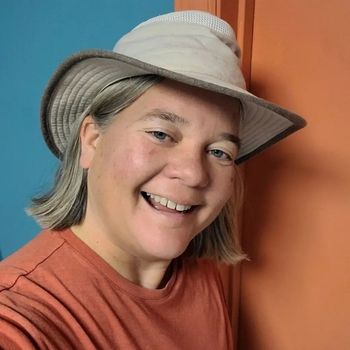
Julie McElmurry didn’t know how to make a documentary so when she won a $1000 grant to make one, she started Googling. When she needed in-person classes, she started the Charlotte Unconventional Film School, which filled 800 seats with adult learners in its third year. She loves demystifying things and believes that knowledge is meant to be shared. She thinks everybody should build onramps so other people can get into cool new worlds. She works for various film festivals, produces a live Story Teller’s Open Mic in Charlotte & Raleigh, is Program Manager for a documentary organization called The D-Word and helps filmmakers get unstuck. Her website is www.nonfictional.org and she wants you to know that you can make a documentary too.
Make that Documentary Yourself!
Do you know what the number one thing is you need to be able to make a documentary?
You actually already have it.
It’s access.
Who do you know? Nobody else is going to make a documentary about them. If they like you well enough and trust you, they’ll let you talk to them with that camera off to the side. Don’t put the camera between you and them and hide behind it. This is a real conversation. You can learn how to edit and if you have empathy and perception, the timing of that will become clear with experience.
April’s Fools… I mean our brilliant April, 2026 show presenters!
Amanda Brock Morales, Postdoctoral Researcher at the University of North Carolina at Charlotte with a PhD in Anthropology/ Archaeology. Amanda’s research is based in the North Central Andes of Peru in a highland community called Huaylas. I collaborate with community members to document oral histories of place and excavate the archaeological site of Chupacoto to gain a deeper understanding of the past.
“When Places Are People: Stories From Work at the Archaeological site of Chupacoto in the Peruvian Andes”
In the Peruvian Andes, an archaeological site is not just a pile of stones, rather it can be a person with moods, preferences, obligations, and a long memory. Chupacoto, the 4,000-year-old archaeological ceremonial center where I work, is one of these beings. Families still live on its ancient platforms, build their houses atop its bedrock foundations, and interact with it through rituals, stories, and offerings. In the town of Huaylas, people don’t talk about Chupacoto, they talk with it.
In my talk, I will explore what it means to live alongside a huaca, which is a place in the Andes that has agency to act, feel, and respond to humans. I’ll share local lore, including tales of midnight bulls with bells ringing, ghosts appearing in the night, tunnels that lead to the heart of the site, and encounters with the devil, to explore how these stories encode relationships of respect, reciprocity, and care with the archaeological site. We’ll look at how descendant communities that live on and near the site continue to co-exist with Chupacoto as a present-day force in their daily lives and also examine how archaeologists work in a landscape that is not only inhabited by people, but by places with agency.
Margarita Nigmatullina, Founder MindMatter LLC. Margarita is a systems thinker working at the intersection of technology, behavior, and decision-making. She previously worked as a Senior Business Intelligence Engineer at Truist, focusing on data analytics, governance, and AI-driven solutions. She is the founder of MindMatter, where she explores how attention, cognition, and patterns shape the way we think, act, and interact. Her work integrates insights from psychology, neuroscience, and systems thinking, combined with real-world observation, to better understand modern behavior. Margarita is also the creator of Who Are We, Mom?, a children’s book series exploring cultural identity and belonging.
“Games People Play: Why a 60-Year-Old Psychology Book Explains Modern Behavior So Well.”
In 1964, psychiatrist Eric Berne introduced the concept of psychological “games” in his book Games People Play: recurring interaction patterns with hidden payoffs that keep people stuck while feeling completely justified. In this talk, I will briefly introduce Berne’s framework, explain what a psychological “game” is and why these patterns exist, and then focus on one specific game:
“Why Don’t You — Yes, But.”
This is not therapy and not a lecture.
It’s pattern recognition for people who like systems, with slides, visuals, and probably some uncomfortable laughter when you realize you’ve played this game before.
Eric Hoenes del Pinal, Associate Professor, Religious Studies, UNCC. Religion and culture; ethnography of religion; language and communication. Eric Hoenes (B.A. Boston University; Ph.D. University of California, San Diego) joined the UNC Charlotte faculty in 2013. Trained as a cultural and linguistic anthropologist, his approach to the study of religion is strongly ethnographic, with an emphasis on the role of language and non-verbal forms of communication in shaping human interaction. His research interests include the study of global Christianity, the politics of language and culture, and the ethnography of Latin America with special emphasis on indigenous peoples of Mesoamerica.
“When Places Eat People: Stories About the Relationships between People and Landscape in Latin America”
Guatemala’s Q’eqchi’-Maya people understand the world as being inhabited by a broad range of other-than-human beings whose lives and fates are variously interconnected to the natural and social geography of the country. This talk will examine stories collected in 2024 about one such being— a body of water who occasionally feeds on human flesh to sustain itself. I’ll explain how stories about this and some other related figures illustrate some of the key cultural and ethical values around food and feeding and how that helps us understand Q’eqchi’-Maya people’s understanding of their place in the world.
It’s our first show! Be prepared for Swords and Sorcery! Or, more accurately, Historical European Martial Arts and Magic, the Occult, and Marginalized Religious Practices in America.
January 2026 Presenters:
Jessie Harrigan:
She started fencing at 14 years old, competing in sabre. This continued through college before becoming a sabre and footwork coach for UTK’s fencing club until graduation. She took a hiatus from swords to dabble in other contact sports, including BJJ and kickboxing. However, the siren song of stabbing people drew her back into sword fighting, wherein she discovered Historical European Martial Arts. She’s been learning and teaching about all manner of pointy weapons ever since.
Historical European Martial Arts
This presentation will give everyone a glimpse of Historical European Martial Arts in all of its deadly, maiming, sometimes silly glory, along with how we know what we know and what you can learn at Swordwind Historical Swordsmanship, Charlotte’s local HEMA club. If you’ve ever wanted to test the waters of how to legally hit your friends with swords, here’s where to start!
Heather Freeman:
Professor of Art in Digital Media at UNC Charlotte, and my research has focused on sharing humanities and social science scholarship on religious studies, spirituality, and ‘occulture’ with lay audiences. Heather’s last big project was the NEH-funded, PRX podcast series Magic in the United States.
“10 Things Every American Should Know About Magic.”
‘Magic’ means esoteric, occult, spiritual, and marginalized religious practices. In these last two cases, ‘magic’ is generally a pejorative, but this will be talking about the living practices and beliefs of diverse Americans throughout this country’s history, right to this present day — perhaps especially today.
Michael E. Murray:
Local Voiceover Talent. He holds a Master’s in Ethics and Applied Philosophy from UNC Charlotte, and graduated Summa Cum Laude with Departmental Honors in Art History, also from UNCC. He was a faculty Teaching Assistant as both Graduate and Undergraduate, for Philosophy and Art History and now he’s the Host and Boss of Nerd Nite Charlotte.
“Dungeons & Dragons and the Devil: The 80’s Satanic Panic.”
Critical Role and Stranger Things have played no small role in D&D’s surge in mainstream popularity over the past decade, but there was a time this improvisational fantasy game was belittled as the nerdiest of nerdy hobbies. So, why was this nerdy little game targeted by some of the most powerful religious and political forces in America? And what happened? Semiotics, politics, and a little religious history thrown in the mix.