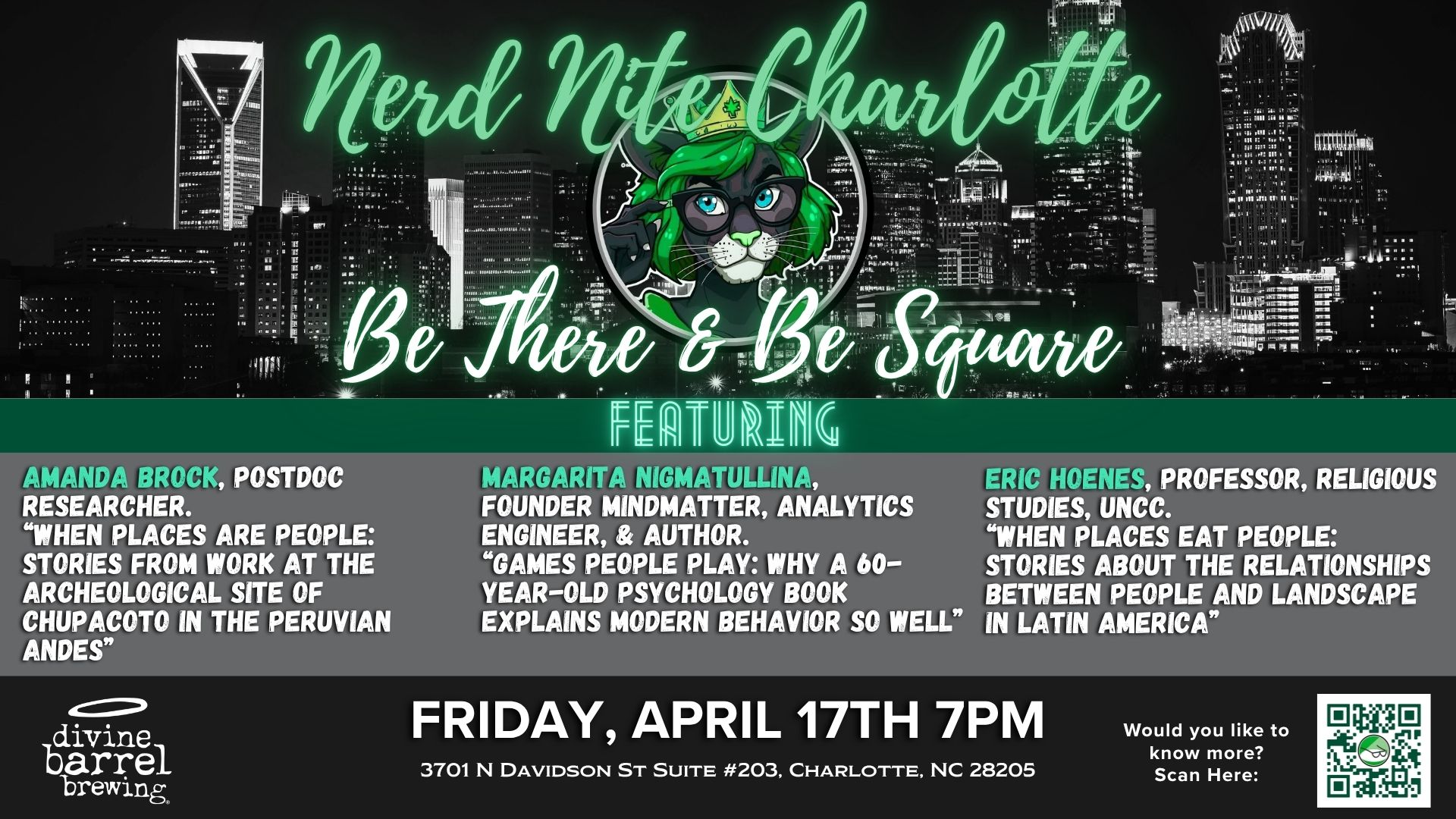
Nerd Nite Charlotte is BACK! Our next show is scheduled for April 17th at Divine Barrel in NoDa. Doors open at noon, show starts at 7pm!
April’s Fools… I mean our brilliant presenters!
Amanda Brock Morales, Postdoctoral Researcher at the University of North Carolina at Charlotte with a PhD in Anthropology/ Archaeology. Amanda’s research is based in the North Central Andes of Peru in a highland community called Huaylas. I collaborate with community members to document oral histories of place and excavate the archaeological site of Chupacoto to gain a deeper understanding of the past.
“When Places Are People: Stories From Work at the Archaeological site of Chupacoto in the Peruvian Andes”
In the Peruvian Andes, an archaeological site is not just a pile of stones, rather it can be a person with moods, preferences, obligations, and a long memory. Chupacoto, the 4,000-year-old archaeological ceremonial center where I work, is one of these beings. Families still live on its ancient platforms, build their houses atop its bedrock foundations, and interact with it through rituals, stories, and offerings. In the town of Huaylas, people don’t talk about Chupacoto, they talk with it.
In my talk, I will explore what it means to live alongside a huaca, which is a place in the Andes that has agency to act, feel, and respond to humans. I’ll share local lore, including tales of midnight bulls with bells ringing, ghosts appearing in the night, tunnels that lead to the heart of the site, and encounters with the devil, to explore how these stories encode relationships of respect, reciprocity, and care with the archaeological site. We’ll look at how descendant communities that live on and near the site continue to co-exist with Chupacoto as a present-day force in their daily lives and also examine how archaeologists work in a landscape that is not only inhabited by people, but by places with agency.
Margarita Nigmatullina, Founder MindMatter LLC. Margarita is a systems thinker working at the intersection of technology, behavior, and decision-making. She previously worked as a Senior Business Intelligence Engineer at Truist, focusing on data analytics, governance, and AI-driven solutions. She is the founder of MindMatter, where she explores how attention, cognition, and patterns shape the way we think, act, and interact. Her work integrates insights from psychology, neuroscience, and systems thinking, combined with real-world observation, to better understand modern behavior. Margarita is also the creator of Who Are We, Mom?, a children’s book series exploring cultural identity and belonging.
“Games People Play: Why a 60-Year-Old Psychology Book Explains Modern Behavior So Well.”
In 1964, psychiatrist Eric Berne introduced the concept of psychological “games” in his book Games People Play: recurring interaction patterns with hidden payoffs that keep people stuck while feeling completely justified. In this talk, I will briefly introduce Berne’s framework, explain what a psychological “game” is and why these patterns exist, and then focus on one specific game:
“Why Don’t You — Yes, But.”
This is not therapy and not a lecture.
It’s pattern recognition for people who like systems, with slides, visuals, and probably some uncomfortable laughter when you realize you’ve played this game before.
Eric Hoenes del Pinal, Associate Professor, Religious Studies, UNCC. Religion and culture; ethnography of religion; language and communication. Eric Hoenes (B.A. Boston University; Ph.D. University of California, San Diego) joined the UNC Charlotte faculty in 2013. Trained as a cultural and linguistic anthropologist, his approach to the study of religion is strongly ethnographic, with an emphasis on the role of language and non-verbal forms of communication in shaping human interaction. His research interests include the study of global Christianity, the politics of language and culture, and the ethnography of Latin America with special emphasis on indigenous peoples of Mesoamerica.
“When Places Eat People: Stories About the Relationships between People and Landscape in Latin America”
Guatemala’s Q’eqchi’-Maya people understand the world as being inhabited by a broad range of other-than-human beings whose lives and fates are variously interconnected to the natural and social geography of the country. This talk will examine stories collected in 2024 about one such being— a body of water who occasionally feeds on human flesh to sustain itself. I’ll explain how stories about this and some other related figures illustrate some of the key cultural and ethical values around food and feeding and how that helps us understand Q’eqchi’-Maya people’s understanding of their place in the world.

Calling all Nerds! Anyone interested in speaking about anything from Astrophysics to Kaiju Zoology, check out our presentation guidelines HERE.

Name our Mascot! Click the banner above and submit your suggestion in the Contact form, the top 5 will go to a poll on our social media and the winner will be announced at an upcoming show!